Monday, April 30, 2012

another stranded accusative

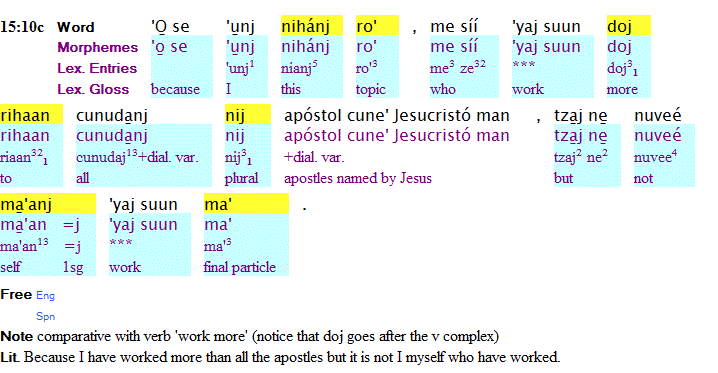
The following example shows another stranded accusative in a relative clause context.  There is an interesting overlap with the funny syntax of the verb achiin 'need', which has the reverse linking relative to the English verb.  In Triqui, the subject of achiin is the thing which is needed and the person who needs it is the object of the verb, often preceded by accusative man.

Acts 4:34

Friday, April 27, 2012

Adjectives with the existential copula

Still wondering about the syntax of a couple of adjectival or verb psychological predicates that must appear with vaa 'exist'  or its potential aspect form gaa.  These seem rather like verbs, and can be transitive, but they don't vary for aspect, which is instead shown by the existential.

Several examples in this subsense of the word vaa:


Interlinear versions of some sample passages:


The 'free'  construction described in the previous blog entry also has the vaa before it.

Wednesday, April 25, 2012

'Tough' adjectives in Triqui

I've been wondering about a class of adjectives in Copala Triqui that seem in their syntax a bit like English  'It is tough for X to Y'.

One such adjective is ya'núj 'be free, be available'.  It shows up with a syntax like the following:

Exist ya'núj rihaan NP [V (pro)...]


meaning

NP is free to V


as in the following example:


Monday, April 23, 2012

The database for Colonial Valley Zapotec

Here is a link  to the paper that Brook Lillehaugen and I gave at the COLOV conference on languages of Oaxaca.

And here is an image of the title slide:

Sunday, April 22, 2012

Presentation at the Coloquio

I'm at the Coloquio sobre lenguas otomangues y vecinas today.  Here's the title slide of the presentation I give this afternoon:


Here is a link to the whole thing on Academia.edu

Monday, April 16, 2012

We have concluded the creation of man

A passage I've been working on in Colonial Valley Zapotec.  The verb /zaloo/ is still unidentified for now.


Monday, April 9, 2012

Causatives in Colonial Valley Zapotec

Does the following passage from the Feria Doctrina (1567) show a /ko-/ or /go-/ causative prefix?  I don't think modern Valley Zapotec languages have this morpheme:


Thursday, April 5, 2012

Male and female fetuses and 'ensoulment' in the Zapotec doctrina

According to the Zapotec doctrina (Feria 1567) that I am analysing, male and female fetuses develop for different amounts of time before they receive their souls. (Click the image to enlarge it.)


(I still don't have a lot of the grammar worked out in this section...)

This Wikipedia article says that this idea of 'ensoulment'  goes back to Aristotle, though the article there says 40 days for males and 90 days for females.  One consequence in the early church was that some considered the abortion of a fetus before 'ensoulment'  not to be murder, but some more minor offense. So it was permissible, in some views, to abort a female fetus at a later stage than a male fetus.  (Though how would someone in the early church be able to tell the sex of a fetus??)

More philosophical that the usual blog posts!

Stranded accusatives in Copala Triqui in negative fronting

In this previous post and this previous post, I discussed stranded accusative particles in relative clauses.  The following examples show the same stranding process in the negative fronting construction:


Wednesday, April 4, 2012

Thinking in Triqui, continued + ni'yaj puzzles

The following passage shows the funny interaction between the rá 'think' construction and the question particle, namely in a passage 'Do you think this is the man who used to sit and beg...?'  what is really being asked is something like [in your thoughts [is this the man who used to sit and beg?] ].  The Triqui order is
[This is the man who used to sit and beg][you think][question].  The 'thinking' construction is discussed here, here, and here

Another puzzle -- does ni'yaj mean 'look at' in this passage?  The passersby look at the formerly blind man, but when they look at him, they also have a particular thought/attitude of surprise toward him.


Tuesday, April 3, 2012

Ni'yaj psych complements again

In previous posts, I've discussed the unusual word ni'yaj, which is followed by an NP that has a psychological attitude toward the preceding clause.

The following shows a subtle use of the ni'yaj marker of psychological attitude.  Here there is literal seeing, but I believe the intention of the passive is that witnessing the resurrected Jesus eat caused the disciples to change their psychological state (i.e. believing that it was really him).


Sunday, April 1, 2012

Timucua talk for Reno

Working today on the Powerpoint for my talk in Reno on Timucua texts.  Here is the cover slide


Saturday, March 31, 2012

draft of the Zapotec valence chapter

I finished and sent off my draft for the chapter on valence morphology in San Dionisio Ocotepec Zapotec today.  It is intended for a volume from Brill that Aaron Sonnenschein and Natalie Operstein are editing.

Here is the beginning of it.  Write me if you would like a copy of the draft.


Wednesday, March 28, 2012

Ni'yaj psych complements continued

In a previous post, I talked about the unusual verb ni'yaj in Copala Triqui, which is used to convey a psychological attitude by some participant in a text toward another participant.

The following example is interesting, since 'illuminate/shine'  isn't a psychological verb.  But in combination with ni'yaj, we get the reading 'It seemed to me as if his face was shining'.  Here the overlap with another sense of ni'yaj 'see'  is fairly clear, but not all psychological uses involve vision.


Tuesday, March 27, 2012

Another stranded accusative

In a previous post, I mentioned the possibility of stranding the accusative marker in a relative clause.  Here is another example from a text:


More Condition D in Triqui

Another example of a potential Condition D violation in Copala Triqui:


This may be more evidence that the 'think'  clause is syntactically subordinate, though semantically superordinate.  ('Went to the river...' is thus an insubordinate clause..)

Monday, March 26, 2012

resumptive pronoun after ro' topic in Triqui

In a previous post, I discussed topic marking and mentioned resumptive pronouns.  The following shows another example of a resumptive pronoun after the ro' topic in Copala Triqui.


Sunday, March 25, 2012

Speakers in the Timucua texts

Here are two nice charts showing the different patterns of the distribution of bo and buo in two Timucua texts.

Two forms of the plural in the Confessionario

Two forms of the plural in the 1612 Catechism

As I said in a previous post, I think this pattern shows that there were different Timucua speakers who are the unnamed coauthors of these texts.

Saturday, March 24, 2012

Different speakers in Timucua texts

I've been looking at the distribution of some variable parts of Timucua grammar for what they tell us about the speakers and dialects.

One tentative conclusion is that there are two sub-dialects represented in the religious materials.  One dialect has -bo consistently for the plural marker, while the other uses both -bo and -buo for the same morpheme.  Call the first one the BO dialect and the other the BUO dialect

Some documents are entirely BO.  For documents in the second dialect, we get a mix of the two.  In the 1612 Catechism, for example, we get about 60% bo and 40% buo.    In this respect, the Confessionario is an interesting case.  It is BO up to about folio 138, then switches to BUO until about 153, then reverts to consistent BO dialect.

These screenshots are from a little spreadsheet with the folio number and which variant appears.  (Y = bo, N = buo).


An interesting conclusion -- possibly not so surprising, if you think about the context.   Although Francisco Pareja is listed as the 'author' of both texts, clearly the Timucua in the two is different, so I would say that they have different, unnamed, Timucua co-authors.

Monday, March 19, 2012

Comparatives in Triqui, 2

In a previous post, I mentioned comparatives in Copala Triqui.

The following example shows the comparative doj between the two parts of the compound verb niha' rá 'be happy'.  Compare that with the example in the previous post (repeated below) which shows the doj after the second part of the verb compound.  I think this is because niha' rá and  'yaj suun are in different classes of verb compounds.