Showing posts with label stranding. Show all posts

Monday, April 30, 2012

another stranded accusative

The following example shows another stranded accusative in a relative clause context.  There is an interesting overlap with the funny syntax of the verb achiin 'need', which has the reverse linking relative to the English verb.  In Triqui, the subject of achiin is the thing which is needed and the person who needs it is the object of the verb, often preceded by accusative man.

Acts 4:34

Thursday, April 5, 2012

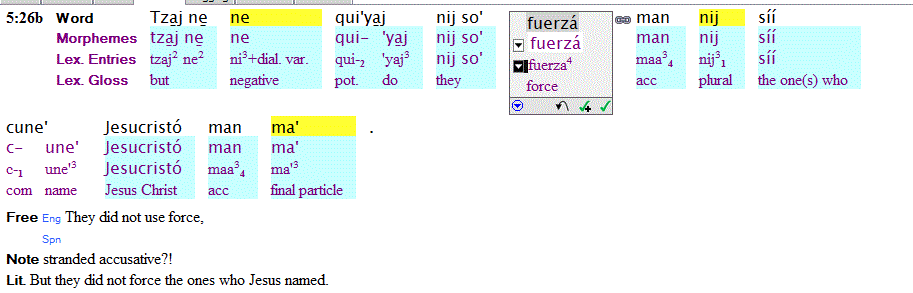
Stranded accusatives in Copala Triqui in negative fronting

In this previous post and this previous post, I discussed stranded accusative particles in relative clauses.  The following examples show the same stranding process in the negative fronting construction:


Tuesday, March 27, 2012

Another stranded accusative

In a previous post, I mentioned the possibility of stranding the accusative marker in a relative clause.  Here is another example from a text:


Saturday, February 18, 2012

Negative construction in Copala Triqui

The contrastive negative construction in Copala Triqui has the form

Nuveé {NP|PP} [S...]   "It is not {NP|PP} that ...."


For contrasting the object of a preposition, both preposition stranding and pied-piping of the PP are possible.  This example shows pied-piping:


Stranded prepositions in Copala Triqui, continued

In this previous post and this previous post, I talked about stranded material in Copala Triqui.

In the texts, the richest natural source of stranding is found in relative clauses.  Consider the following complicated passage, which has two strandings of rihaan 'to':


Another context for naturally occurring strandings is the contrastive negation construction Nuveé NP V... 'It is not NP that...'


The last clause here is literally 'It is not God who they give that meat to'

Saturday, February 11, 2012

Fronted phrases with maan in Triqui

I'm looking tonight at phrases with maan, which is rather inadequately glossed 'only' in my current lexicon.

The phrase preceded by maan is always (I think) clause initial and has some special discourse function -- maybe focus.  (I need to work out how it is different from the ro' topics, clefts with me se, etc...)

This topical phrase is sometimes a time adverb (either orá or tio, two words borrowed from Spanish, that mean 'time'):


It can also be a noun phrase.  In the following example, the cactus fruit with spines contrasts with the nice cactus fruits without spines which the rabbit threw in the previous episodes.


(This example also has preposition stranding in the fronted phrase)

Friday, February 3, 2012

More stranded accusatives in Copala Triqui

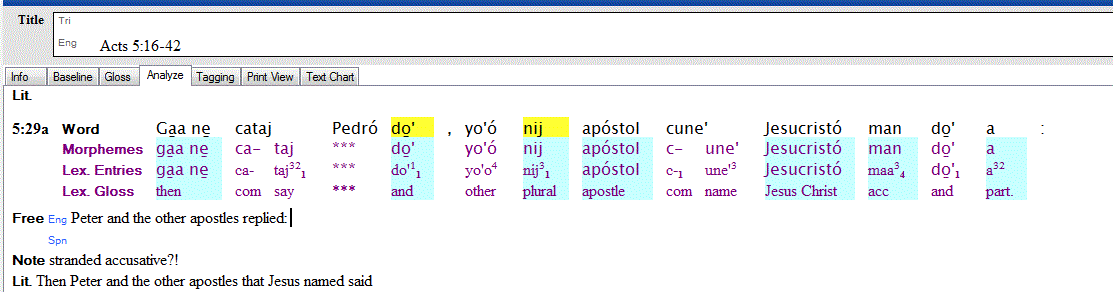
In an earlier post on this blog, I talked about stranded accusatives in Copala Triqui.  Here is another example from Acts:


This phrase 'the apostles that Jesus named'  is the same as a phrase in the earlier post, but this time in a topicalized position, followed by ro'.

More uses of the ni'yaj psychological attitude marker in Copala Triqui

The following passages from the Triqui new testament show  interesting additional uses of the ni'yaj morpheme in Copala Triqui. (Described in a previous post.)

The syntax is [Spoke Greeks [ni'yaj they ACC Hebrews about ... ]] and the somewhat idiomatic reading seems to be 'the Greeks complained of the Hebrews that they...'.


This seems to show that a word that is not inherently a psychological attitude verb (like 'speak') can be converted to a psychological attitude verb by using the ni'yaj morpheme.

The following passage is similar, this time with 'think well SUBJ ni'yaj (pron) man NP':


The subject here is the indefinite nii, so this phrase means 'those who people speak well of'.  Note another stranded accusative marker!


Tuesday, January 31, 2012

Stranded prepositions in Copala Triqui

Stranded prepositions are certainly possible in Copala Triqui, but mostly I have them from elicitation.  So it is nice to come across occasional examples in text:


Sunday, January 29, 2012

Stranded accusatives in Copala Triqui

A small lesson for me on why it is useful to work through texts -- you encounter things that you would not have known were possible.  Today I found three examples of stranded accusative markers in the Copala Triqui New Testament translation, and this is a construction that I did not know was grammatical!


I think it probably important that all of these appear in relative clause contexts -- ''the apostles that Jesus named ACC", "the ones that Jesus named", and "the ones that you put in jail ACC".