Showing posts with label colonial. Show all posts

Monday, May 11, 2015

Tecticpac documents in the typology of Zapotec orthographies

In this previous post, I outlined two criteria that seem to distinguish different schools of Colonial Valley Zapotec orthography:
a.) spellings of /r/: in Mexicanist orthographies usually spelled , but in Oaxacanist orthographies usually spelled .
b.) use of doubled vowels : the Oaxacanist tradition uses them about twice as frequently as the Mexicanist tradition.

In this respect, a group of documents written in the town of Tecticpac between 1610-1626 are interesting.  The documents in question are


These documents seem like the earlier Mexicanist writing, in that use of doubled vowels is not common, but this group of documents is also fascinating since it shows variable use of .
(More details on t/r in Tecticpac in a following post.)

Friday, May 8, 2015

The Ticha project

Here is a video of me talking about the work that we are doing on the Ticha project

Ticha: A Digital Text Explorer for Colonial Zapotec


An overview of the project is at Ticha.

My talented collaborators on the project are Brook Lillehaugen, Michel Oudijk, Laurie Allen, and Enrique Valdivia.  And Haverford undergrad May Plumb has been doing a fabulous job as a student assistant.

Orthographic variants in Colonial Valley Zapotec

Continuing on the thread from yesterday, I'm working on identifying other words in Colonial Valley Zapotec whose spelling varies in some notable way from text to text.

One such word is bitoo ~ bitao 'God'.  In Feria (1567) and Cordova (1578), this is consistently spelled with a single in the first syllable.  In Aguero (1666) and Levanto (1732) the spelling has shifted to biitoo.

Thursday, May 7, 2015

Different orthographic traditions in Colonial Valley Zapotec

I've been using our FLEx database recently to correlate an intuition I have had after looking at lots of Colonial Valley Zapotec texts -- that there are some patterns in the spelling that are indicative of at least two different orthographic traditions.

I've labeled the two traditions the Mexicanist and the Oaxacanist traditions.  Important texts in the Mexicanist tradition include Feria's (1567) Doctrina and Cordova's (1578) Vocabulario and Arte.  The oldest texts in Zapotec are in the Mexicanist orthography.

Important texts in the Oaxacanist tradition include Aguero's (1666) Miscelanea Espiritual and Levanto's (1736/1776) Cathecismo


I've found two main diagnostics so far:
  vs

  1. The Mexicanist orthography imitates the spelling of Nahuatl and avoids use of the letters , even though Colonial Valley Zapotec almost certainly had phonemes /b, d, g, r, u/.   One very frequent morpheme in CVZ is the aspect marker /r(i) ~ r-u-/.  (The two allomorphs are correlated with different verb classes, and the verb classes are correlated with transitivity.)   Texts in the Mexicanist tradition spell this aspect prefix as or .
  2. The Oaxacanist orthography has begun to depart from the Mexicanist orthography in the spelling of /r/, and regularly uses and .


doubled vowels


  1. Modern Valley Zapotec vowels have distinctions of stress, phonation type, and tone. (Interrelated in somewhat intricate ways.)  Colonial Valley Zapotec must have had at least stress and tone distinctions, though they are not marked in a very regular way in the orthography.  The Mexicanist orthography occasionally marks vowels with a grave or acute accent, and occasionally doubles a vowel.   However use of doubled vowels is relative unusual.  
  2. The Oaxacanist orthography uses doubled vowels much more liberally than the Mexicanist orthography.  (At approximately twice the rate.)
The following chart shows the rates of as a portion of all in the four documents surveyed.

Saturday, September 13, 2014

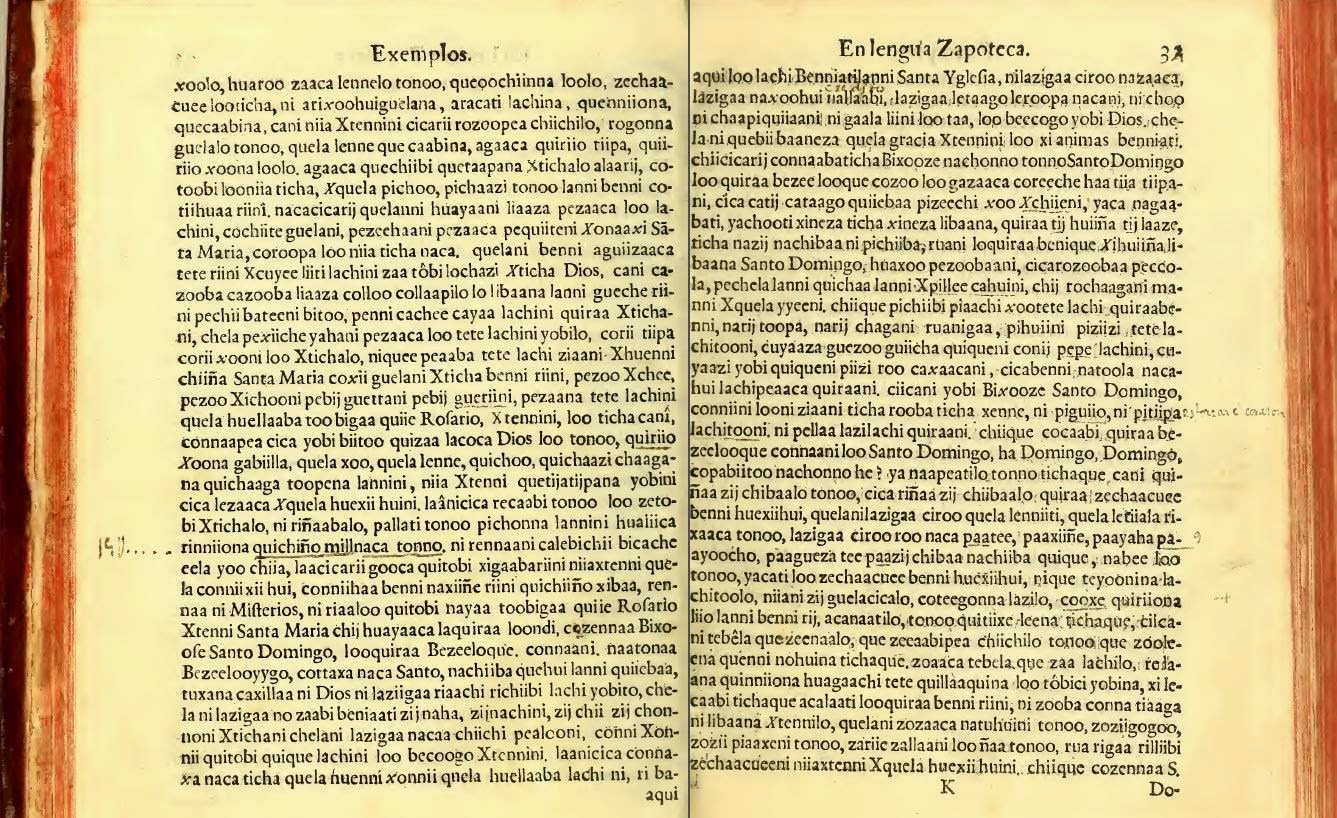
St Dominic cures a demoniac: Tentative matching between Zapotec and Spanish

Much of Aguero (1666) is monolingual Zapotec, but most of it seems to be translated from Spanish originals.  Locating similar Spanish texts is key to working out the Zapotec.  The following Zapotec exemplum ("St Dominic cures a demoniac")  seems to me to a probable match for the miracle of the Rosary in Alonso Fernandez (here).


The likely correspondence in Alonso Fernandez is the following:


Saturday, August 30, 2014

Pronominal diversity in Central Zapotec and the Animal pronoun =me in Colonial Valley Zapotec

One great puzzle of Colonial Valley Zapotec is the divergence between the pronominal systems of modern Valley Zapotec languages and that of the colonial texts.

To the best of my knowledge, all (or nearly all) of the modern Valley Zapotec languages distinguish 3rd person clitic pronouns for humans, animals, and inanimates.  The smallest system seems to have three such distinctions (e.g. Guevea de Humboldt Zapotec).  The largest system seems to be San Lucas Quiaviní.

The following chart summarizes my understanding of the typical range of clitic pronouns available.  I have used color as follows --

B1(front vowel), e.g. bi, be, ëb
B2(back vowel). e.g. bu, ba
ZH (ʒ), e.g. zha, zhi, azh
M(vowel), e.g. ma, mu, me, mi, emm
NI1 (low or non-glottal), e.g. ni, ing, yn
NI2 (high or glottal), e.g. ni', ní, ni'i


San Dionisio OcotepecSan Lucas QuiaviniTeotitlanSan Juan GuelaviaSanta Ana del ValleChichi-capanAyoquescoZaachilaCoatecasMitlaGueveaAlbarradasIsthmus (Juchitan)Tehuantepec
my notesMunro and Lopezcited in MacLauryJonescited in MacLaurycited in MacLaurycited in MacLauryBriggsMarks, p,.c. (updated since the publication)AdamGramatica popularcited in MacLaury
3 respect or honorba, abazh:nybubaxa'amán
3 ordinarybi, ebyangbï, bbibia'nnimembe
3 m --> mzhazhï, zhzhízh
3 animalma, amëmmmmï, mmumamama'bmeme
3 saint or reverentialni'ni', inyni'inini
3 inanimateniingnini(i)nynuannini
3 formalëb
3 childne'ni'
3 malembeve
3 femalezhace
3 proximalëng
3 distalih
3 impersonal
Some generalizations:

B1 and B2 pronouns are always used for humans.
If a lg has both B1 and B2B2 represents a higher degree of respect.
If a lg has one of the B pronouns and NI1 (low or non-glottal), the B pronoun is almost always higher in honor than NI1.  (Guelavia is not an exception if the ny is a reflex of NI2.)
Nearly all lgs have M(vowel) as the animal pronoun.  
The Albarradas inversion of M and B pronouns is remarkable.  It is the only attested language with this system.
The use of M pronouns for people is unique to Albarradas and Guevea and may indicate an shared innovation.

In contrast to this situation, most Colonial Valley Zapotec uses only one pronoun =ni.

However, in the 1666 text by Cristobal Aguero Miscelanea espiritual, I have discovered two instances of what appears to be the animal pronoun, spelled mee in the text:


This is (I think) the earliest attested use of the animal pronoun in CVZ.

Wednesday, August 13, 2014

Feria (1567) Sacrament of confirmation in Colonial Valley Zapotec

Feria, Doctrina f104v 'Sacrament of confirmation'

Analysis of Feria, Doctrina f104v 'Sacrament of confirmation' (This section of the text starts on the second paragraph of the page.)

Cetanalaga 
cetanalaga 
follows 
cotopa 
co- 
PERF 
topa 
two 
Sacramento 
Sacramento 
sacrament 
.

Here follows the second sacrament.
Siguesse el segundo sacramento.

Cotopala 
co- 
PERF 
topa 
two 
la 
la 
loo 
loo 
aspect, kind 
sacramento 
sacramento 
sacrament 
nàca 
STA 
àca 
be able; can 
quela 
quela= 
NOM= 
huecaapea 
hue- 
AGN 
caapea 
confirm 
bixoce 
bixoce 
father 
obispo 
obispo 
bishop 
.

The second is confirmation.
El segundo es la confirmacion.

Chi 
chi 
when 
tocaa pea 
to- 
HAB:CAUS 
caapea 
confirm 
bixoce 
bixoce 
father 
coqui 
coqui 
lord 
Obispo 
Obispo 
bishop 
tòtila 
tòti 
some (animate) 
=la 
=indef 
beni 
beni 
person 
,
chicani 
chicani 
then 
topaloo 
topa 
two 
loo 
aspect, kind 
taca 
t- 
HAB 
aca 
be(not-PERF/PRF) 
:
cotobiloo 
co- 
PERF 
tobi 
one 
loo 
face 
tigabini 
ti- 
HAB 
gabi 
anoint 
=ni 
=3 
benî 
benî 
give 
cani 
cani 
this 
tobi 
tobi 
one 
nocuana 
nocuana 
herb, medicine 
nachono 
na- 
STA 
chono 
be.valuable; be valuable 
tete 
tete 
very 
,
ninocha 
topa 
topa 
two 
nocuana 
nocuana 
herb, medicine 
tobilâ 
tobi 
one 
=lâ 
=and 
azeyte 
azeyte 
oil 
,
cetobilâ 
ce- 
again 
tobi 
one 
=lâ 
=and 
balsamo 
,
ticha 
ticha 
word 
castilla 
castilla 
Castillian 
,
Cotopa 
Co- 
PERF 
topa 
two 
loo 
loo 
aspect, kind 
tocaa 
to- 
HAB:CAUS 
caa 
take 
bixoce 
bixoce 
father 
Obispo 
Obispo 
bishop 
bennabi cruz 
bennabi cruz 
sign of the cross 
loo 
loo 
aspect, kind 
lo cuaa 
lo cuaa 
forehead 
benicani 
beni 
person 
cani 
this 
.

When the bishop confirms someone, two things happen. One is that he anoints him with a very precious liquor, composed of two liquors, which are balsam and oil: the other is that he makes the sign of the cross on the forehead.
Quando el obispo confirma a alguno, dos cosas se hazen. La una es, que le unge con un liquor muy preciado, compuesto de dos liquores, que son balsamo y azeyte: lo otro es que le haze la señal de la cruz X en la frente.

Quitopa 
qui- 
IRR 
topa 
two 
loo 
loo 
aspect, kind 
nitij 
nitij 
this 
tolohuini 
to- 
HAB:CAUS 
lohui 
=ni 
=3 
quela 
quela= 
NOM= 
coego 
christiano 
christiano 
Christian 
,
nicocañeni 
ni 
in.that 
co- 
PERF 
cañe 
=ni 
=3 
,
ni 
ni 
REL 
pigabañe 
pi- 
PERF 
gabañe 
pertain, go with 
quitaalij 
quitaalij 
all(IRR-all-straight) 
beni 
beni 
person 
,
chicoxijni 
chi 
when 
co- 
PERF 
xij 
receive(notIRR) 
=ni 
=3 
quela cotobaniça 
quela cotobaniça 
baptism 
,
oalijca 
oa 
PRF 
lij 
straight, true 
=ca 
=EMPH 
ticàpea 
ti- 
HAB 
càpea 
beni 
beni 
person 
Christiano 
Christiano 
Christian 
bennabi cruz 
bennabi cruz 
sign of the cross 
locuaani 
locuaa 
forehead 
=ni 
=3 
,
niani 
niani 
for 
quiyennini 
quiy- 
IRR 
enni 
understand 
=ni 
=3 
,
cacapeani 
cacapea 
know 
=ni 
=3 
ticha 
ticha 
word 
yanaquîñati 
ya= 
NEG= 
na- 
STA 
quîña 
be.necessary 
=ti 
=NEG 
,
cocachini 
co 
IRR 
cachi 
be.burried 
=ni 
=3 
looquela 
loo 
face 
quela 
nom 
Christiano 
Christiano 
Christian 
xitenini 
xi- 
POSS 
teni 
possession 
=ni 
=3 
,

Both of these two things show the Christian army, to which all men who have received the holy baptism are obligated and subject. The Christian is shown on the forehead with the sign of the cross: X so that he understands and knows that he does not have to hide or cover the fact of being a Christian.
Entrambas estas dos cosas significan la milicia christiana, a que esta obligado, y subjecto todo hombre, que ha rescebido el sancto baptismo. Es señalado el christiano en la frente con la señal de la cruz: X para que entienda, y cognozca, que no ha de esconder, ni encubrir el ser que tiene de christiano.


References