Showing posts with label thinking. Show all posts

Wednesday, April 4, 2012

Thinking in Triqui, continued + ni'yaj puzzles

The following passage shows the funny interaction between the rá 'think' construction and the question particle, namely in a passage 'Do you think this is the man who used to sit and beg...?'  what is really being asked is something like [in your thoughts [is this the man who used to sit and beg?] ].  The Triqui order is
[This is the man who used to sit and beg][you think][question].  The 'thinking' construction is discussed here, here, and here

Another puzzle -- does ni'yaj mean 'look at' in this passage?  The passersby look at the formerly blind man, but when they look at him, they also have a particular thought/attitude of surprise toward him.


Tuesday, February 21, 2012

Thinking in Triqui, part 3

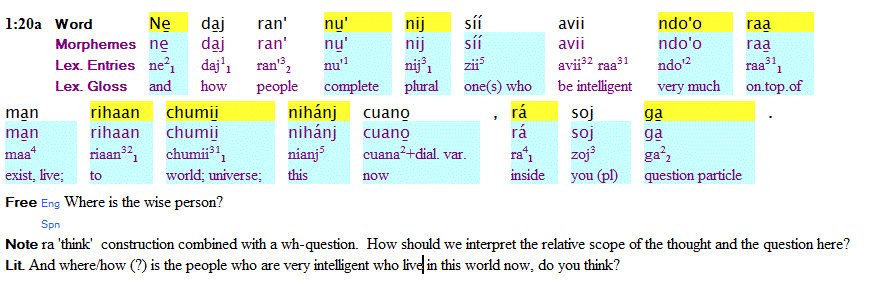
In this previous post and this previous post, I discussed the unusual thinking construction in Copala Triqui.  The examples for today show the combination of a question and the thinking construction.   In Triqui, ga is the usual question particle for wh-questions, and na' is for yes-no questions.  Note that in these examples, the choice of question particle is sensitive to the main question -- not the 'do you think' part of the sentence.

That seems to imply to me that the constituency has the  NP portion as a parenthetical, and the question particle goes with the main sentence, roughly

[abc [rá NP] question particle]


where abc represents the clause that is being thought about.


Wednesday, February 15, 2012

More examples of the Triqui thinking construction

In this post and  this post, I talked about the strange syntax of the 'thinking construction'  in Copala Triqui, where some long clause [abc] is followed by rá NP, and the effect is to give NP's expectations, thoughts, hopes, desires about the situation described in [abc].

The following example is another strange one, and like a previous example, it might involve condition D violations if we try to interpret rá NP as the superordinate clause:


Here it is very hard to know if the material within the scope of  includes the 'Herod thought...' part of the sentence.  Maybe not?

I don't think the aspect of the verbs tells us anything, since both completive and potential verbs can be in the scope.

Wednesday, February 8, 2012

Thinking in Triqui, part 2

More examples of the thinking construction:

1.) The scope of the [ABC] portion seems to extend from ca'vee nuchruj raa  'it would be possible for them to think about' up to the 'Peter and John' just before rá.


2.) In this example, the [ABC] contains the noun phrase 'fox', and the  is followed by the animal pronoun xo'.  So if the first clause were subordinate to the 'it thought' portion, then we would have a "Condition D" effect, where a pronoun c-commands a coreferential r-expression below it.  Copala Triqui has plenty of standard Condition C violations (John saw John), but I am not sure that Condition D violations ("He saw John", where he=John) are otherwise allowed.


Thinking in Triqui

Copala Triqui has an unusual syntax for recounting people's thoughts in a text.  Rather than 'X thought [ABC]', the usual Triqui syntax is '[ABC], rá X'.  (I am not completely sure, but I think that other orders with rá are not possible; at least none occur in natural texts.)

Sometimes [ABC] itself maycontain another verb that implies thought, like me rá 'want'.

Questions that I do not know the answer to about this construction:
a.) Logically it seems that [ABC] is subordinate to "X thinks", but is there syntactic evidence for the relationship between the two clauses?
b.) Does it have the same syntax as the similarly reversed causative construction '[ABC] caused X'?
c.) How large is the possible scope of the material before rá? How do I know where the left edge of the [ABC] unit is to be found?
d.) Are there any restrictions on the person/number of the subject?  (I have only seen it for 2nd or 3rd person X, but maybe other uses are possible...)
e.) Is it possible for X to be null? I have transcriptions of some passages that seem to show this pattern, but I am not 100% sure that they are right.
f.) Any restrictions on the aspect or other elements of the [ABC] materials?

Here are some examples:
1.) In this example, the wants/thoughts of public hypocrites are described.  The scope of rá seems to extend back to the me rá 'want' verb, since the two potential aspects on 'speak' and 'see' are triggered by the presence of these verbs in the complement of 'want'.

2.) In this example, it seems like the final question particle ga logically goes with the 'Which woman is my mother?' part of the sentence, not with the 'you think' part. (I.e. the sentence does not mean 'Do you think which woman is my mother?') Also ga typically shows up with wh-questions, not yes-no questions, so it is linked to the 'which woman'...


3.) Here is a case where the 'thinker' is the same as the subject of [ABC], and seems to be null in the syntax.  This passage bears on question (e) above, but I want to have more examples to be sure that this is correctly analysed.