Showing posts with label exempla. Show all posts

Monday, January 23, 2017

The Timucua word for spider

Reading through various miracle stories in Pareja's (1627) Catechismo y Examen, I came across the story below which deals with a blasphemer who was eaten by a giant spider. Here I give the text and a rough analysis. The word for 'spider' appears to be satala, though it only appears once in the story. This is currently the only instance of the word in the corpus.

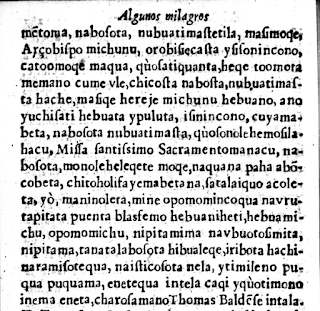
Much about the analysis of this story is not entirely worked out, but the climax of the story is satala iquo acoleta, yò, maninoleta, mine opomomincoqua navrutapitata, which seems to mean literally "a very big (iquo aco) spider, one that was frightening (yò manino), came down (pita) accompanied by (na-uruta) its thread (opomo)"


CatEx f287r-v [A giant spider eats a heretic]

1.1
Hicaco
hica
village
-co
coord
Londres
Londres
*London
mononco
mono
call
-nco
RelCl
Inglaterrabeta
Inglaterra
*England
beta
oblique
S
San
saint
Pablo
Pablo
Paul
Yglesiamitononco
Yglesia
church
-mitono
his (respectful)
-nco
RelCl
,
inincono
Canturia
Canturia
*Canterbury
Arçobispo
mucuqua
mucu
in the presence of
-qua
nsuff
ytahosta
ytaho
unknown verb [denounce?]
-s
benef
-ta
part
ysimonincono
ysi
say
-mo
Pl:A
-ni
-ncono
determiner? article?
,
ychiqecheno
ychiqecheno
shoe
parema
pare
sew
-ma
art
,
yaha
yaha
one
herejeleta
hereje
heretic(s)
-leta
indef
SS
Sacramento
Sacramento
*sacrament
,
nabosota
na-
ins
boso
honor, praise
-ta
part
,
nubuatimastetila
nubuatima
show reverence
-s
benef
-te
part
-ti
neg
-la
aff
,
§
In the city of London in England in the church of St Paul, it is told that they denounced a heretic shoemaker before the Archbishop of Canterbury, who had no reverence for the most holy Sacrament.
En la ciudad de Londres en Inglaterra en la Yglesia de S Pablo aconteciò, que denunciaron à un çapatero hereje delante del Arçobispo de Canturia, que no hazia ninguna reverencia al santissimo SACRAMENTO,
1.2
masimoqe
masi
say
-mo
Pl:A
-qe
if
Arçobispo
michunu
-michunu
RelCl
,
"
orobisiecasta
orobisi
behave badly
ecasta
ysisonincono
,
catoomoqe
ca-
thus
toomo
after
-qe
if
maqua
-ma
art
-qua
comparative
,
quòstatiquanta
,
heqe
heqe
now
toomota
toomo
after
-ta
part
memano
-mi
ordinal
-mano
top
cume
cume
heart, chest, soul
vle
vle
humility
,
chicosta
chico
bite, strike
-s
benef
-ta
part
nabosta
nabo
praise
-s
benef
-ta
part
,
nubuatimasta
nubuatima
show reverence
-s
benef
-ta
part
hache
=hache
=imper
,"
§
The archbishop exhorted him that from then on he should revere it with humility, and the heretic replied shamelessly that a spider was more worthy of reverence.
Exortòle el Arçobispo, que de alli adelante lo reverenciase humilmente, y el hereje con mucha desverguença le respondiò, que una araña era mas digna de reverencia.
1.3
masiqe
masi
say
-qe
and then
hereje
hereje
heretic(s)
michunu
-michunu
RelCl
hebuano
hebuano
word
,
ano
ano
person
yuchisati
yuchisati
hebuata
hebua
speak
-ta
part
ypuluta
ypulu
reply (with hebua)
-ta
part
,
isinincono
,
cuyamabeta
cuya
-ma
art
beta
oblique
,
nabosota
na-
ins
boso
honor, praise
-ta
part
nubuatimasta
nubuatima
show reverence
-s
benef
-ta
part
Sacramentomanacu
,
nabosota
na-
ins
boso
honor, praise
-ta
part
,
monoleheleqete
mono
call
le
cop
-heleqete
not at all
moqe
mo
say
-qe
and then
,
naquana
naquana
without delay
paha
paha
house
abõcobeta
abo
high location
-nco
indef
beta
oblique
chitoholifa yemabetana
chito
head
holifa yema
betana
,
satala
satala
spider
iquo
iquo
large
acoleta
acole
very
-ta
part
,
feel horror/hatred/repugnance
,
maninoleta
mani
feel horror/hatred/repugnance
-no
nmlz
-leta
indef
,
mine
mine
opomomincoqua
opomo
spiders web
-mi
3poss
-nco
RelCl
-qua
if
navrutapitata
na-
ins
vru
accompany
-ta
part
pita
descend
-ta
part
puenta
puen
come
-ta
part
blasfemo
hebuaniheti
hebuani
word
heti
evil, demon
,
hebuamichu
hebua
speak
-michu
prev mention
,
opomomichu
opomo
spiders web
-michu
prev mention
,
nipitama
nipita
mouth
-ma
art
,
tanatalabosota nela
ta=
away=
na-
ins
talabo
put in mouth?
-so
caus
ta nela
,
§
And at that moment from the peak of the roof, a giant and frightening spider came down and wrapped its thread around the blasphemer, and put him it in its mouth.
Y al momento de lo alto de la cu[m]bre del techo, bajando una grandissima y espantosa araña endreçando su hilo al blasfemo, se le puso en la boca.
1.4
ytimileno
ytimileno
father (or priest)
puqua puquama
puqua puqua
in abundance
-ma
art
,
enetequa
ene
see
-tequa
so that
intela
in
be
-te
part
-la
aff
caqi
caqi
this
yquòtimono
yquòtimono
miracle, mystery
inema
inema
all
eneta
ene
see
-ta
part
,
charosamano
Thomas
Baldense
intala
.
Escrive este milagro Tomas valdense, que se hallò presente, con otros muchos Prelados. tom. 2. c. 62. contra Vuielepho.

Monday, July 4, 2016

The miracle of the Jewish boy saved from the furnace

One of the miracles of the sacrament related in the 1627 Catechismo y Examen is the story of a Jewish boy who consumes a piece of the Host at school.  In a rage, his father puts him in an oven.  But miraculously, after three days, he is taken out unharmed.

Here is a brief English summary:


Here are the Spanish and Timucua versions:


Obviously, this story has very nasty historical associations with European anti-Semitism.  Who knows what the Timucua must have thought of these stories of European Jews?

Saturday, June 27, 2015

Bishop Andres and the tempting devils

Movilla (1635) contains a series of exampla translated into Timucua.  The first in the series is a story about a Bishop Andres, who was tempted by devils to molest a saintly woman living in his house.  The devils were defeated in the following way: A Jew was passing by on the road, and took shelter in a pagan shrine at night.  Before going to bed, he crossed himself for protection. While there, he saw a band of demons recounting their temptations of humans, including the demon who was tempting Andres.  The Jew is protected from the demons by the cross, and when he leaves, he find the Bishop, who after several denials, finally confesses his sin.  The Jew is then converted.


The original of this seems to be due to St Gregory, in the following passage
St Gregory Book Three Chapter 7.  (And in fact the Timucua translation cites this place.)  The Spanish that accompanies the text, however, looks more like this 1607 text: Tratado del govierno de la familia, y estado del matrimonio, by a Jesuit Gaspar Arete.  Or this version from 1597:


A few notable changes -- in the original by Gregory, the place where the Jew spends the night is a temple of Apollo.  In the Spanish 1607 version, it is a "templo de un idolo caydo" [temple of a fallen idol], and in the 1597 version it is "un templo antigua que estava alli de un idolo" [old temple where there was an idol] but in Movilla's Spanish version it is a "sepultura de infieles" [a tomb of unbelievers].  The parallel Timucua calls the place paha yanqua anopira Christianoti, nihitecare yalenolebinco = 'a house where they buried non-Christian Indians who died.'

Tuesday, September 30, 2014

St Macarius and the demon carrying bottles

I've been enjoying tracking the little stories embedded in the Colonial Zapotec and Timucua materials.

Here is one story in Spanish and Timucua from the 1613 Timucua Confessional:


My transcription and translation of the Spanish:

No sólo la sacramental confesión cierra la boca al Demonio para que no pueda acusar al pecador, y le confunda: pero aún abre el secreto que tiene en el alma de él que de veras se convierte a Dios, por cuya revelación pierde Satanás, todo el derecho que tenía en el pecador. Qui denuntiat arcana amici fidem perdit. Él que descubre los secretos pierde la amistad del amigo secreto. Escondido del Demonio es el pecado en alma del pecador, la confesión santa le descubre y revela, y descubierto pierde la inicua amistad, que el pecador tenía con la antigua serpiente, lo que sumamente deberíamos procurar. 

Encontrando San Macario al demonio, todo cargado de redomillas, le preguntó, “Qué significan esas redomillas?” [f30] Respondió Satanás, “Bebidas son que doy a los monjes, cuando los tiento y llevo tantas porque si no quieren beber, de una beban de otra.” “Dime,” preguntó Macario, “Y bebió de ellas alguno?” Respondió el Demonio, “Teoristo bebió de ellas.” Dada esta respuesta, desapareció el enemigo. Como fuese San Macario a donde estaban los monjes, y le saliese ellos a recibir con palmas en sus manos fuese derecho a la celda de Teoristo, rogándole se confesase con él, de todos sus pensamientos, lo cual hizo el monje con mucha humildad tornando a encontrar el Santo al Demonio le preguntó, cómo le iba con sus monjes, respondió que mal, porque ya todos quedaban santificados por medio de la confesión

Ninguna cosa tanto desagrada al Demonio cuanto el revelarle los secretos por eso se colgó Achitofel, porque Cusi reveló su secreto, y traición a David, ninguno encomendará su secreto de buena gana, a los que son muy parleros, y así el Demonio, a los que son muy solícitos en las confesiones, de mala gana encomienda los secretos de sus malas sugestiones y pecados, porque ve, que le guardan la mala fidelidad, que él quería. Cesareo cuenta, que fue a París, un gran Teólogo y afamado Predicador, el cual estando una vez en su oratorio, vio al Demonio a quién conjurando, preguntó “Cuál es la cosa entre los hombres, que más pesadumbre, y enojo os da a vosotros?” Respondió Satanás, “Ninguna cosa nos da tanta molestia, ni nos quita tanto las fuerzas, cuanto la pura y limpia confesión. Cuando está el hombre, en pecado mortal todo le tenemos atado porque no cumpla la voluntad de Dios, sino la muestra, por confesados sus pecados queda luego libre, de nuestras manos, y hábil para toda buena obra.” Lo mismo respondió el Demonio, al Angelico Doctor Santo Tomas.


(My translation)

The sacramental confession doesn’t only close the mouth of the Devil so that he can’t accuse the sinner, and confuse him [the devil], but it even opens the secret that he [the devil?] has in the soul of him who truly converts himself to God, through whose revelation Satan loses all right that he had to the sinner. “He that discloseth the secret of a friend loseth credit.”[1] He who discovers secrets loses the friendship of the secret friend. Hidden by the Devil is the sin in the soul of the sinner; the holy confession discovers and reveals it, and discovered loses the nefarious friendship which the sinner had with the ancient serpent, that which we should extremely try to do. 

Saint Macario, encountering the devil, all packed with little bottles, asked him, “What do those little bottles mean?” Responded Satan, “They are drinks that I give to the monks when I tempt them, and I carry so many because if they don’t want to drink from one, they drink from another.” “Tell me,” asked Macario, “And did someone drink from them?” Responded the Devil, “Teoristo drank from them.” Having given this response, the enemy disappeared. Then San Macario went  to where the monks were, and they left to receive him with palms in their hands; he went right to Teoristo’s cell, begging him to confess himself with him of all his thoughts, which the monk did with great humility. The Saint returning to find the Devil, he asked him how it went with his monks. [The devil] responded that [it went] badly, because they all were now sanctified through the method of confession. 

Nothing displeased the Devil as much as revealing his secrets; because of this Achitofel hung himself, because Cusi revealed his secret and betrayal of David. No one will entrust his secret willingly to those who are very talkative, and in this way the Devil, to those who are very obliging in the confession, grudgingly entrusts the secrets of his evil suggestions and sins, because he sees that they harbor unfaithfulness, which he wanted. Cesareo says that a great Theologian and famed Preacher went to Paris, who being one time in prayer, saw the Devil; conjuring him, he asked, “What is the thing among men which gives you the most grief and anger.” Responded Satan, “Nothing gives us more trouble, nor takes strength from us as much as pure and clean confession. When a man is in mortal sin, we have all of him tied, because he doesn’t fulfill the will of God; but it is shown to him through having confessed his sins, he remains afterwards free from our hands, and able to do any good work.” The same responded the Devil to the Angelic Doctor Saint Thomas.

==
I was able to find another version of the Spanish story here on Google Play:


Significant I think, is that this version is followed by the same discussion of Achitofel and Chusi that follows the San Macario episode in Timucua.


This book 

Libro intitulado Iornadas para el Cielo

by Cristobal Moreno (O.F.M) published in 1596 seems like the source for many things in the Timucua confessional.

Saturday, September 13, 2014

St Dominic cures a demoniac: Tentative matching between Zapotec and Spanish

Much of Aguero (1666) is monolingual Zapotec, but most of it seems to be translated from Spanish originals.  Locating similar Spanish texts is key to working out the Zapotec.  The following Zapotec exemplum ("St Dominic cures a demoniac")  seems to me to a probable match for the miracle of the Rosary in Alonso Fernandez (here).


The likely correspondence in Alonso Fernandez is the following:


Tuesday, September 9, 2014

The devoted shepherdess: The Timucua version

In my last post, I described Spanish and Zapotec versions of an exemplum I will call The devoted shepherdess.  The following version of the story is from Gregorio de Movilla (1635):


A few notable differences between the earlier Spanish version and this one:
  1. The identity of the priests as Dominicans is not mentioned here.  (The Timucua version is produced by Franciscans.)
  2. The meaning of the different clothing for the maidens is explained by their different degrees of piety in this version, but not in the Alonso Fernandez version.
  3. The death of the parents is mentioned here, but not in the Alonso Fernandez version.