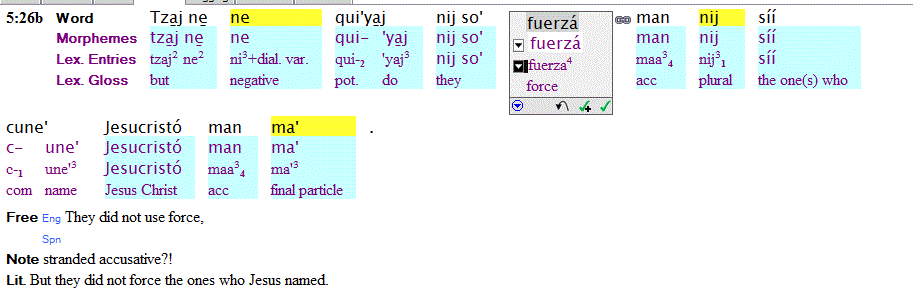
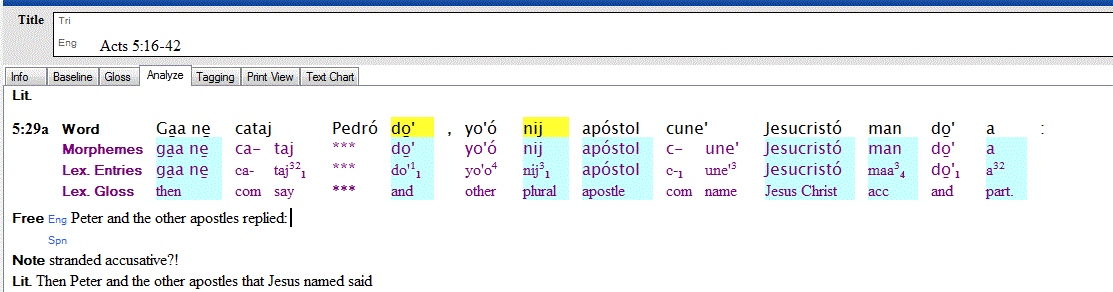
In a previous post, I mentioned the possibility of stranding the accusative marker in a relative clause. Here is another example from a text:
An inside view of the daily working life of a linguist interested in language description and linguistic theory. (Click on any image below to enlarge it.)
Showing posts with label relative clauses. Show all posts
Tuesday, March 27, 2012
Tuesday, March 13, 2012
Relative clauses in Triqui
The following example shows a relative clause formed on the possessor of the subject 'one whose children believe in Jesus'. It's interesting that there is no resumptive pronoun or other syntactic indication of the possession relation here -- though perhaps the fact that the possessor form of child appears is the signal of the relation.
| Titus 1:6 |
Saturday, February 18, 2012
Stranded prepositions in Copala Triqui, continued
In this previous post and this previous post, I talked about stranded material in Copala Triqui.
In the texts, the richest natural source of stranding is found in relative clauses. Consider the following complicated passage, which has two strandings of rihaan 'to':
Another context for naturally occurring strandings is the contrastive negation construction NuveƩ NP V... 'It is not NP that...'
The last clause here is literally 'It is not God who they give that meat to'
In the texts, the richest natural source of stranding is found in relative clauses. Consider the following complicated passage, which has two strandings of rihaan 'to':
Another context for naturally occurring strandings is the contrastive negation construction NuveƩ NP V... 'It is not NP that...'
The last clause here is literally 'It is not God who they give that meat to'
Labels:
accusative,
negative,
prepositions,
relative clauses,
stranding
Sunday, January 29, 2012
Stranded accusatives in Copala Triqui
A small lesson for me on why it is useful to work through texts -- you encounter things that you would not have known were possible. Today I found three examples of stranded accusative markers in the Copala Triqui New Testament translation, and this is a construction that I did not know was grammatical!
I think it probably important that all of these appear in relative clause contexts -- ''the apostles that Jesus named ACC", "the ones that Jesus named", and "the ones that you put in jail ACC".
Labels:
accusative,
relative clauses,
stranding,
testament,
Triqui
Subscribe to:
Posts (Atom)