Showing posts with label Zapotec. Show all posts

Friday, May 15, 2015

Zapotec language map (Central Valley)

I came across a map from Thomas Smith Stark's classification of Zapotec languages recently.  (They were unfortunately not in the printed volume, but were a supplement...)

The following shows the grouping of Zapotec languages in the Central Valley east of the city of Oaxaca:


Monday, May 11, 2015

Tecticpac documents in the typology of Zapotec orthographies

In this previous post, I outlined two criteria that seem to distinguish different schools of Colonial Valley Zapotec orthography:
a.) spellings of /r/: in Mexicanist orthographies usually spelled , but in Oaxacanist orthographies usually spelled .
b.) use of doubled vowels : the Oaxacanist tradition uses them about twice as frequently as the Mexicanist tradition.

In this respect, a group of documents written in the town of Tecticpac between 1610-1626 are interesting.  The documents in question are


These documents seem like the earlier Mexicanist writing, in that use of doubled vowels is not common, but this group of documents is also fascinating since it shows variable use of .
(More details on t/r in Tecticpac in a following post.)

Saturday, May 9, 2015

Rhyming poetry in Colonial Zapotec

There is a strong tradition of poetry for modern Zapotec.  See this essay for a nice over view of some important contemporary poets.

I was interested to find an example of rhyming poetry in Zapotec in a Rosary written in 1732 (republished in 1766) by Levanto.   Here is a sample:

==============================
Hay una tradicción muy fuerte de poesía en la lengua zapoteca contemporanea.  Hay un revista aquí (en inglés) del trabajo de unos poetas importantes.

Pero me interesaba a encontrar un ejemplo de poesía zapoteca de rimas en un rosario de 1732 (republicado en 1766) por Levanto.  Aquí es una muestra:


The rhyme scheme here is   |   El esquema de rima aquí es 
a
b
b
a
c
d
d
c

Friday, May 8, 2015

The Ticha project

Here is a video of me talking about the work that we are doing on the Ticha project

Ticha: A Digital Text Explorer for Colonial Zapotec


An overview of the project is at Ticha.

My talented collaborators on the project are Brook Lillehaugen, Michel Oudijk, Laurie Allen, and Enrique Valdivia.  And Haverford undergrad May Plumb has been doing a fabulous job as a student assistant.

Orthographic variants in Colonial Valley Zapotec

Continuing on the thread from yesterday, I'm working on identifying other words in Colonial Valley Zapotec whose spelling varies in some notable way from text to text.

One such word is bitoo ~ bitao 'God'.  In Feria (1567) and Cordova (1578), this is consistently spelled with a single in the first syllable.  In Aguero (1666) and Levanto (1732) the spelling has shifted to biitoo.

Thursday, May 7, 2015

Different orthographic traditions in Colonial Valley Zapotec

I've been using our FLEx database recently to correlate an intuition I have had after looking at lots of Colonial Valley Zapotec texts -- that there are some patterns in the spelling that are indicative of at least two different orthographic traditions.

I've labeled the two traditions the Mexicanist and the Oaxacanist traditions.  Important texts in the Mexicanist tradition include Feria's (1567) Doctrina and Cordova's (1578) Vocabulario and Arte.  The oldest texts in Zapotec are in the Mexicanist orthography.

Important texts in the Oaxacanist tradition include Aguero's (1666) Miscelanea Espiritual and Levanto's (1736/1776) Cathecismo


I've found two main diagnostics so far:
  vs

  1. The Mexicanist orthography imitates the spelling of Nahuatl and avoids use of the letters , even though Colonial Valley Zapotec almost certainly had phonemes /b, d, g, r, u/.   One very frequent morpheme in CVZ is the aspect marker /r(i) ~ r-u-/.  (The two allomorphs are correlated with different verb classes, and the verb classes are correlated with transitivity.)   Texts in the Mexicanist tradition spell this aspect prefix as or .
  2. The Oaxacanist orthography has begun to depart from the Mexicanist orthography in the spelling of /r/, and regularly uses and .


doubled vowels


  1. Modern Valley Zapotec vowels have distinctions of stress, phonation type, and tone. (Interrelated in somewhat intricate ways.)  Colonial Valley Zapotec must have had at least stress and tone distinctions, though they are not marked in a very regular way in the orthography.  The Mexicanist orthography occasionally marks vowels with a grave or acute accent, and occasionally doubles a vowel.   However use of doubled vowels is relative unusual.  
  2. The Oaxacanist orthography uses doubled vowels much more liberally than the Mexicanist orthography.  (At approximately twice the rate.)
The following chart shows the rates of as a portion of all in the four documents surveyed.

Monday, October 6, 2014

Zapotec poetry

 
A working attempt to come up with a good English translation of this beautiful poem by Esteban Rios Cruz.

Diidxa’ guicaa Julio Ubiidxa

Esteban Rios Cruz

1

Beeu chii 
Beeu chii 
beeu chii 
October 
October 
napa 
n- 
n- 
stat 
apa 
apa 
have 
have 
yeló 
yeló 
yeló 
eye 
eye 
lexu 
lexu 
lexu2 
cottontail rabbit 
cottontail rabbit 
cadxiibi 
ca- 
ca- 
prog 
dxiibi 
dxiibi 
frightened 
frightened 
October has the eyes of a frightened rabbit
Octubre tiene ojos de conejo espantado.

2

Xpeeu 
x- 
x- 
poss 
peeu 
 
moon 
moon 
ni 
ni 
ni 
rel 
rel 
nayaanizisi’ 
nay- 
n- 
stat 
aani 
aani 
lean, hang 
 
lean, hang 
ne 
ne 
ne 
and 
and 
cannibi’ 
ca- 
ca- 
prog 
nnibi’ 
nnibi’ 
move, swing 
move, swing 
lo 
lo 
lo 
to, at 
to, at 
yaga 
yaga 
yaga 
tree 
tree 
Its moon hangs and is swinging in the trees
Su luna brillante columpia sobre los árboles,
I'm not sure about the meaning of the -zisi' part

3

ré’ 
r- 
r- 
hab 
é’ 
é’ 
drink 
drink 
nisa 
nisa 
nisa 
water 
water 
bizé 
bizé 
bizé 
well 
well 
ruché 
ru- 
ru- 
hab:caus 
ché 
ché 
madden, disturb 
madden, disturb 
xpiaani’ 
x- 
x- 
poss 
piaani’ 
piaani’ 
light 
light 
ca 
ca= 
ca= 
plur= 
plur 
bi’cu’ 
bi’cu’ 
bi’cu’ 
dog 
dog 
it drinks well water, it maddens the dogs
bebe agua en los pozos, alucina a los perros
'disturb the light' seems like an idiom, but I'm not sure; not listed in the Isthmus Zapotec dictionary

4

ni 
ni 
ni 
rel 
rel 
rebeeca’ 
re- 
re- 
hab:rep 
bee 
bee 
wake 
=ca’ 
=ca’ 
=3pl 
wake 
xpacaanda’ 
x- 
x- 
poss 
pacaanda’ 
bacaanda’ 
sleep 
sleep 
gueela’ 
gueela’ 
gueela’ 
night 
night 
ne 
ne 
ne 
and 
and 
xquendaridúxhuca 
x- 
x- 
poss 
quenda 
quenda 
nomin 
ri- 
r- 
hab 
dúxhu 
dúxhu 
bark 
=ca 
=ca’ 
=3pl 
nomin 
that wake the night's sleep (with?) their barking
que desvelan a la noche con sus ladridos.

5

Naca’ 
n- 
n- 
stat 
aca’ 
aca’ 
be 
be 
guisbá 
guisbá 
guisbá 
fall? 
fall? 
bi 
bi 
 
wind 
wind 
cadi 
cadi 
cadi 
not 
not 
gapa’ 
g- 
g- 
pot 
apa’ 
apa 
have 
have 
guendarietanala’dxi’ 
guenda 
quenda 
nomin 
ri- 
r- 
hab 
etanala’dxi’ 
etanala’dxi’ 
remember 
remember 
It is fall, the wind can't remember;
Es otoño, el viento desmemoriado

6

canazá 
ca- 
ca- 
prog 
nazá 
nazá 
wander 
wander 
nadxi’ña’ 
nadxi’ña’ 
nadxi’ña’ 
mischievous, naughty 
naughty 
cuxhuxidxi 
cu- 
g- 
pot 
 
xidxi 
xidxi 
laugh 
laugh 
ca 
ca= 
ca= 
plur= 
plur 
diagayoo 
diagayoo 
diagayoo 
window 
window 
it is wandering like a naughty child making the windows laugh.
deambula travieso haciendo reír a las ventanas.


More information about the author here.

Monday, September 15, 2014

St Dominic and the demoniac, continued

Here is a beginning of a translation of the story which is introduced in the preceding post:

Predicando en Francia en la ciudad de Carcasona nuestro Padre Santo Domingo la devocion del Rosario de nuestra Señora, fueron innumerables las personas que con ella reduxo a servir a la Virgen, escriviendose por cofrades suyos. Reparando un herege Albigense en el mucho fruto que desto se seguia, y llevandolo pesadamente, condenava no solo los sermones del Santo, sino su vida, poniendo lengua en su honra. Armava contra el mil testimonios falsos, y con atrevimiento temerario le calumniava la doctrina Catolica que predicava. Desto se siguieron intolerables daños, y muy grandes inconvenientes, porque algunos hereges que estavan dispuestos para abjurar sus errores, y dedicarse por media de la devocion del Rosario a nuestra Señora, se apartavan de resolucion tan importante, perseverando en sus errores. Y queriendo la soberana Reyna del Cielo manifestar al mundo, quan agradable le era esta devocion, por justo juizio de Dios fue el entregado a los demonios, los quales de tal manera el atormentavan, que de los dolores vino a quedar tan rabioso, que con los dientes despedezava sus vestiduras. Y mostrando la furia de muchas maneras, deseavan sus padres reprimirle, y assi le ataron con cadenas de hierro, no le bastando cordeles, porque todos los rompia. Dava vozes, clamores, y gritos, dezia blasfemias, hablava en todas lenguas, y descubria los pecados ocultos de algunos. Sus padres, y amigos, viendo esto, determinaron llevarle a Santo Domingo, y rogarle que pues de otros muchos avia lanzado demonios, se compadeciesse tambien deste miserable.

Estava predicando el Santo a esta sazon la devocion del santissimo Rosaio, y el auditorio era tan grande, que parecia esta alli toda la ciudad.  Llegó el endemoniado a presencia del santo Predicador, y los que le traian, y acompañavan le pidieron con grande instancia le curasse, expeliendo los demonios que le fatiguavan. Cosa maravillosa, que luego se comenzaron a oir en este hombre vozes de muchas personas, que hablavan entre si, con que todos los circunstantes se atemorizavan. Y levantando la voz el bienaventurado Santo Domingo, dixo: Gracias os doy Dios, y Señor mio, que con el testimonio deste hombre, que tanta contradicion me ha procurado hazer, se comprovorá mi doctrina, y bolviendose al endemoniado, prosiguio diziendo: Espiritus malignus, en nombre de santissima Trinidad, y de la bienaventurada Virgen Maria Señora nuestra, y en honor de su Rosario santissimo (de que aora he predicado) os mando, que respondais claramente delante de todo este pueblo a lo que os preguntare, dezidme lo primero:

And in English:

While our Father St Dominic was preaching devotion to the Rosary of our Lady in France in the city of Carcasonne, there were innumerable persons who came to serve the virgin because of it, joining (?) brotherhoods.  An Albigensian heretic, noticing in it much more benefit than in [the heresy] that he followed, and taking it hard, condemned not only the sermons of the Saint, but even his life, raising his tongue against his honor.  He prepared a thousand false testamonies against him, and with frighting gall, he mocked the Catholic doctrine that he preached.  From this came intolerable damage and great problems, because some heretics who were ready to renounce their errors and dedicate themselves to our Lady through the devotion of the Rosary, separated themselves from this very importation resolution, persisting in their errors.  And because the sovereign Queen of Heaven wanted to show the world how agreeable this devotion was to her, through the justice of God, this heretic was possessed by demons, who tormented him so much that he he rabidly tore his clothes to pieces with his teeth.  And filled with fury, his parents wanted to restrain him, and so they tied him with iron chains, since ropes were not enough; he had broken all the ropes.  Speaking in voices, shouts, and screams, he said blasphemies, spoke in all languages, and discovered the hidden sins of others.  His parents and friends, seeing this, decided to carry him to St Dominic and beg him to take compassion on this miserable man, since he had cast demons out of many others.
The saint was preaching at that time the devotion of the most holy Rosary, and the auditorium was so big that it seemed like the whole city was there.  The demoniac arrived in the presence of the holy Preacher, and those who brought him asked insistently that he cure him, casting out the demons that were fatiguing him.  An amazing thing -- that voices of many person started to be heard inside that person, talking to each other, which terrified all those surrounding.  And raising his voice the blessed St Dominic said "I give you thanks, God, My Lord, that with this testimony of this man, who has offered me such opposition, my doctrine will be proved." And turning to the demoniac, he proceeded saying "Evil spirit, in the name of the holy Trinity, and of the blessed Virgin Mary, our Lady, and in honor of her most holy Rosary (which I have now preached), I command you that you respond clearly in front of all this town to all that I will ask you, Tell me first.

Saturday, September 13, 2014

St Dominic cures a demoniac: Tentative matching between Zapotec and Spanish

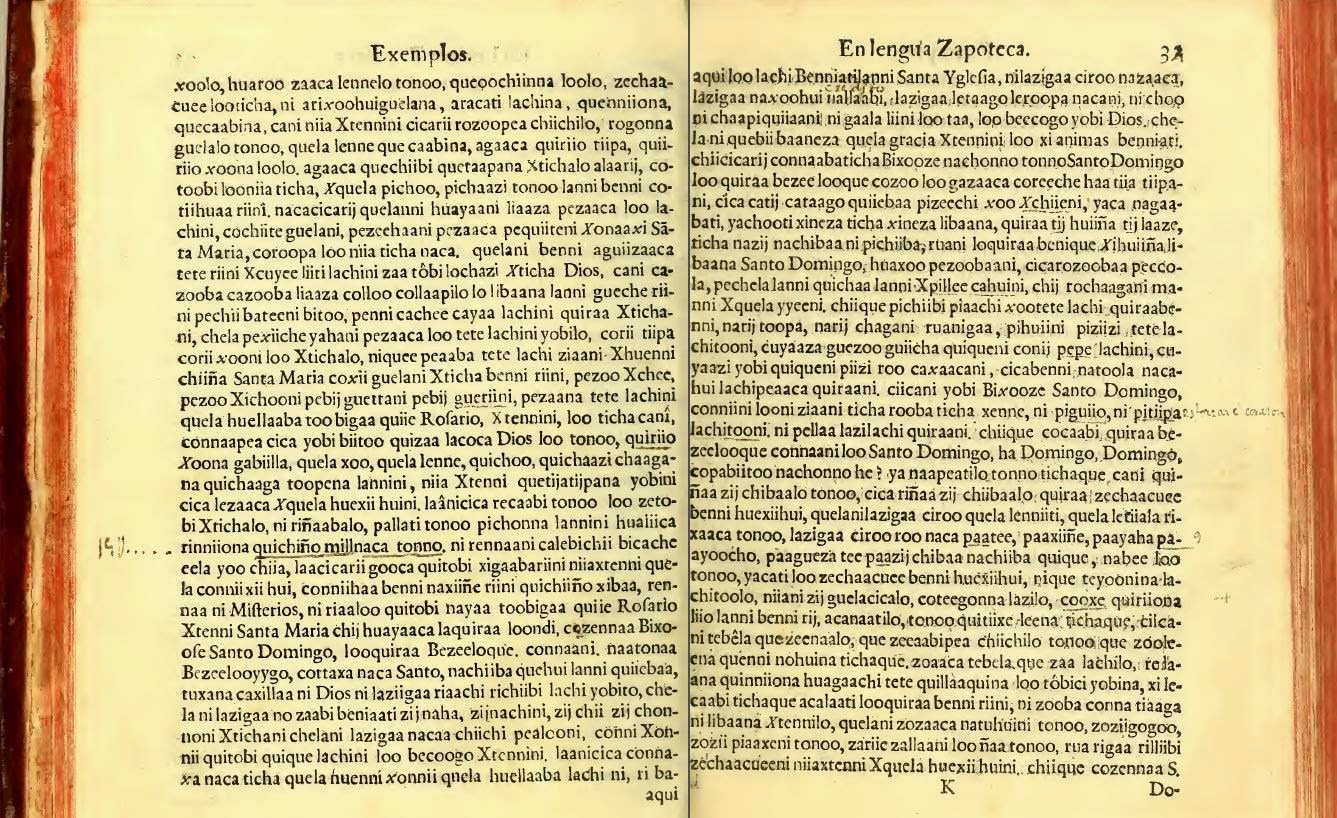
Much of Aguero (1666) is monolingual Zapotec, but most of it seems to be translated from Spanish originals.  Locating similar Spanish texts is key to working out the Zapotec.  The following Zapotec exemplum ("St Dominic cures a demoniac")  seems to me to a probable match for the miracle of the Rosary in Alonso Fernandez (here).


The likely correspondence in Alonso Fernandez is the following:


Monday, September 8, 2014

A monolingual Zapotec exemplum and a possible Spanish original: The devoted shepherdess

Here is a story about a devoted shepherdess from Aguero (1666).


The key to locating the original is the handwritten note "fol 242 F Alonzo Fernandez".    The book is

Historia y anales de la deuocion y milagros del Rosario: desde su origen hasta año mil y seis cientos y veinte y seis : con los fauores de Nuestra Señora a la Orden de Predicadores y seruicios desta familia a su magestad 
 by Alonso Fernandez (1627)
is available at this site at Google Play.

Here is the cover page:


I find the the scanned Google version hard to work with, so here are screen shots of the text:


The same story is also found in Movilla 1635 in Timucua, but many details of the Spanish are different.

Here is a first pass transcript of the Spanish and its translation:

En un aldea guardava una virtuosa pastorzita las ovejas que su pobre padre tenia. Era su exercicio mientras el ganado estava en siesta, ò andava hervajando, recogerse a una pequeña Ermita de nuestra Señora que en aquellos montes avia. En ella con el poco reparo, se juntava estar la Imagen de la Virgen soberana, y de su Hijo, no con aquella decencia de vestidos que era justo. Congoxavase la pobre donzella, viendo quan poco podia para remediar aquella necessidad. Estando un dia alli recogida con un fetuoroso pensamiento, dixo: O Reyna del cielo, quien pudiera componer y vestir esta vuestra Imagen à medida de mis deseos: pero pues no puedo ponerlos en execucion, quieroos dar otros vestidos mejores, y mas a vuestro gusto, que son las Ave Marias del Rosario. En cumplimiento desto perserverò algunos años, yendose cada dia à aquella Ermita à rezar esta devocion. Vino a enfermar de muerte, y estando ya al cabo, yvan caminando dos Religioso de la Orden de Santo Domingo; y passando por cerca de aquella Ermita despoblada, el uno necessitado de un pesado sueño que le sobrevino (no a caso, sino con orden del cielo, para lo que se verà) se recogio à ella à descansar un poco. El otro Religioso se desvio del camino, y debaxo de un arbol començò a rezar sus devociones. Estando rezando, advirtio, que venian por el camino adelante hazia el aldea una gran compañia de donzellas vestidas de ropas de colores, de dos en dos; las quales llegando ante el, le saludaron. Aviendo passado estas, vinieron luego otras hermosas por tordo estremo vestidas de blanco; las quales tambien le hizieron cortesia. Despues vino otro esquadron de Virgenes, cuya hermosura era sobre humana, vestidas de blanco, y carmesi, que traìan como por guia, y Señora à una donzella, que las excedia à todas en hermosura, y Magestad. Traìa el manto sembrado todo de rosas blancas, y coloradas, y en la cabeça una corona, ò guirnalda hecha con maravilloso artificio. A esta Señora suplicò el Religioso le hiziesse merced de dezirle quien era, y la gente que la acompañava, y adonde caminavan. Respondio: Yo soy la Reyna del cielo abogada de los pecadores, que nunca falto à los que con verdad me llaman. Traygo conmigo estas Virgines que has visto, que son del cielo, y vamos à un lugarejo que esta aqui cerca à visitar una devota mia, que me ha hecho un servicio grande, y rezandome cada dia el Rosario; con el qual me ha vestido, y coronado, adornandome qual me ves. Acabando de dezir esto la Virgen, desaparecio con toda aquella celestial compañia. Refirio el santo Religioso el caso a su compañero, que tambien avia tenido la misma revelacion, estando recogido en la ermita. Con deseo de ver el sucesso de tan estraño caso, se dieron priessa à caminar, y llegaron presto al lugar. No hallaron rastro de lo que buscavan; ya que se querian partir, les salio un hombre al encuentro, el qual les guio a una casa pagiza, adonde la pastorzita santa estava echada sobre unas pieles, con un costal de paja a la cabecera: casa pobre de bienes, pero mas rico que han tenido todos los Principes del mundo, por estar aposentada en ella la Reyna del cielo con el acompañamiento dicho. Vieron a su Magestad los Religiosos a la cabecera de aquella dichosa pastora, con una guirnalda de rosas en las manos, esperando que su alma santa se despidiesse de la grosseria de la carne para coronarla, y llevarla consigo. Vieron con las donzellas, que està dicho, muchos Angeles, que con suave, y acordada musica autorizavan la choça, hasta que la santa donzella espirò, y la soberana Virgen con la compañia celestial llevò el alma de la difunta al cielo. Esta revelacion tan en particular aprovechò mucho, para que de aì adelante los Religiosos de santa Domingo predicassen con grande fervor esta santa devocion.

A first translation:

In a village, a virtuous shepherdess watched the sheep that her poor father owned.  It was her habit while the sheep were sleeping or grazing to go to small shrine to our Lady that was in the mountains there.  In it with little [reparo], the image of the sovereign Virgin and her Son were together without the proper decent clothing.  The poor shepherdess was in anguish, seeing how little she could do to fix this necessity.  She was there one day in [fetuoroso] thought and said "O, Queen of Heaven, if only I were able to fix and clothe this your Image in accordance with my desires; but I cannot put them in effect. I want to give you other better clothes, and more to your taste, which are the Ave Marias of the Rosary."  In fulfillment of this, she persisted for some years, coming every day to the shrine to pray this devotion.  
She became deathly ill, and being at the brink, two priests of the order of Saint Dominic came walking by, and passed near that abandoned shrine. A deep need for sleep overcame one of them (not by accident, but by the order of heaven, as we will see), and he went to the shrine to rest a bit.  The other priest left the road, and began to pray under a tree.  As he was praying, he noticed that a large group of maidens in colorful clothes were coming along the road ahead toward the village, two by two.  When they came by him, they greeted him. Then came another group, extremely beautiful, dressed in white; they also greeted him.  After them, came another group of superhuman beauty, dressed in white and crimson, who were led by a Lady who exceeded all in beauty and majesty. She wore a cloak sewn with white and red roses, and on her head was a crown or garland made with marvelous skill.  The priest asked this lady to be so kind as to tell him who she was, who accompanied her, and where they were going. She answered "I am the Queen of heaven, advocate of sinners, who has never failed those who truly call me.  I bring with me these virgins you have seen, who are from heaven, and we are going to a place near here to visit one of my devotees, who has done me a great service, praying the Rosary every day; with this she has clothed me and crowned me, adorning me as you see." As she finished saying this, the Virgin disappeared with all that heavenly company.
The priest explained all this to his companion, who had also had the same revelation while in the shrine.  Wanting to see the outcome of such a strange thing, they walked quickly and soon arrived at the place. They didn't find a trace of what they were looking for, and just as they were about to leave, they met a man who led them to a house made of straw where the holy shepherdess was laid out on some skins, with a sack of straw at her head.  It was a house poor in goods, but richer than all the princes of the world, having been hosted the Queen of heaven with her entourage.  The priests saw her Majesty at the head of that fortunate shepherdess with a garland of roses in her hands, waiting for her soul to leave her crude body in order to crown her and take her away.  They saw along with the maidens, many angels, who serenaded the shack with soft, sweet music until the holy shepherdess died, and the sovereign Virgin and her entourage carried the soul of the deceased to heaven.  This revelation was very beneficial, so that from then on, the priests of St Dominic preached this holy devotion with great fervor.


Tuesday, September 2, 2014

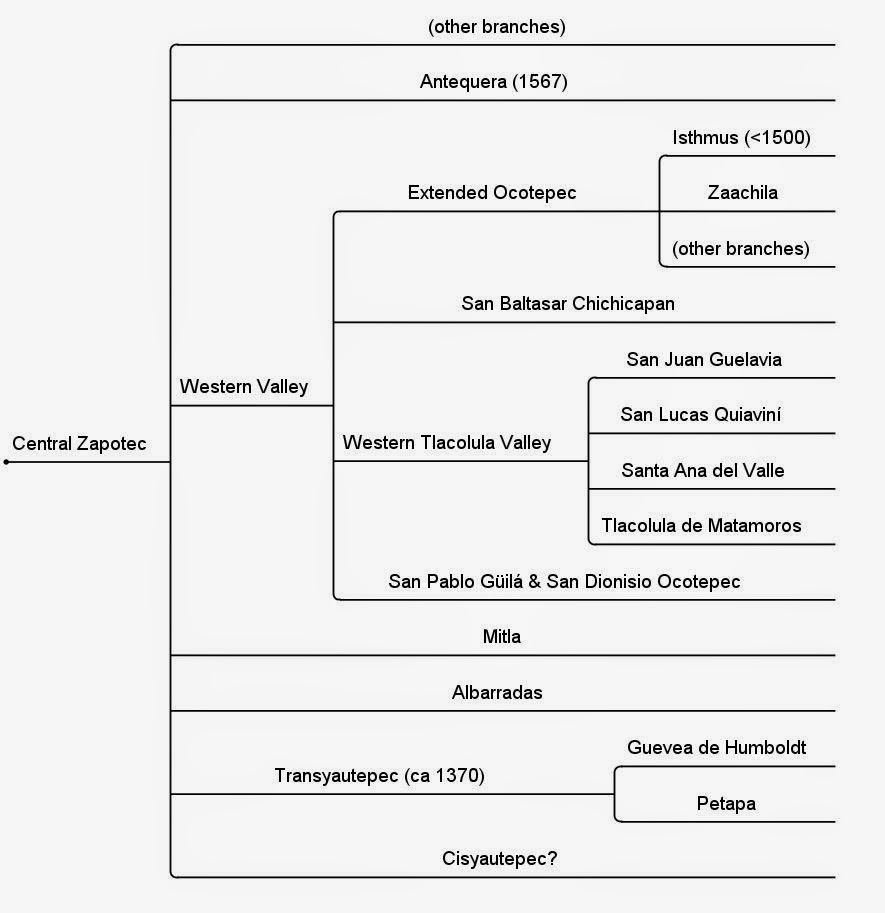
Phylogenetic trees for Zapotec

I've been frustrated by how hard it is to draw decent language tree diagrams for historical linguistics.  Something today made me think to look at the software that evolutionary biologists use, and I found TreeGraph 2.   This is free, and produced the very nice diagrams below.


Saturday, August 30, 2014

Pronominal diversity in Central Zapotec and the Animal pronoun =me in Colonial Valley Zapotec

One great puzzle of Colonial Valley Zapotec is the divergence between the pronominal systems of modern Valley Zapotec languages and that of the colonial texts.

To the best of my knowledge, all (or nearly all) of the modern Valley Zapotec languages distinguish 3rd person clitic pronouns for humans, animals, and inanimates.  The smallest system seems to have three such distinctions (e.g. Guevea de Humboldt Zapotec).  The largest system seems to be San Lucas Quiaviní.

The following chart summarizes my understanding of the typical range of clitic pronouns available.  I have used color as follows --

B1(front vowel), e.g. bi, be, ëb
B2(back vowel). e.g. bu, ba
ZH (ʒ), e.g. zha, zhi, azh
M(vowel), e.g. ma, mu, me, mi, emm
NI1 (low or non-glottal), e.g. ni, ing, yn
NI2 (high or glottal), e.g. ni', ní, ni'i


San Dionisio OcotepecSan Lucas QuiaviniTeotitlanSan Juan GuelaviaSanta Ana del ValleChichi-capanAyoquescoZaachilaCoatecasMitlaGueveaAlbarradasIsthmus (Juchitan)Tehuantepec
my notesMunro and Lopezcited in MacLauryJonescited in MacLaurycited in MacLaurycited in MacLauryBriggsMarks, p,.c. (updated since the publication)AdamGramatica popularcited in MacLaury
3 respect or honorba, abazh:nybubaxa'amán
3 ordinarybi, ebyangbï, bbibia'nnimembe
3 m --> mzhazhï, zhzhízh
3 animalma, amëmmmmï, mmumamama'bmeme
3 saint or reverentialni'ni', inyni'inini
3 inanimateniingnini(i)nynuannini
3 formalëb
3 childne'ni'
3 malembeve
3 femalezhace
3 proximalëng
3 distalih
3 impersonal
Some generalizations:

B1 and B2 pronouns are always used for humans.
If a lg has both B1 and B2B2 represents a higher degree of respect.
If a lg has one of the B pronouns and NI1 (low or non-glottal), the B pronoun is almost always higher in honor than NI1.  (Guelavia is not an exception if the ny is a reflex of NI2.)
Nearly all lgs have M(vowel) as the animal pronoun.  
The Albarradas inversion of M and B pronouns is remarkable.  It is the only attested language with this system.
The use of M pronouns for people is unique to Albarradas and Guevea and may indicate an shared innovation.

In contrast to this situation, most Colonial Valley Zapotec uses only one pronoun =ni.

However, in the 1666 text by Cristobal Aguero Miscelanea espiritual, I have discovered two instances of what appears to be the animal pronoun, spelled mee in the text:


This is (I think) the earliest attested use of the animal pronoun in CVZ.