Showing posts with label negative. Show all posts

Wednesday, April 30, 2014

Early examples of unreal ni- in Colonial Valley Zapotec

The following passage from Feria (1567) shows several probable instances of early uses of the unreal aspect prefix marker ni- in negative and hypothetical situations.

Feria f22v


Sunday, May 6, 2012

Negative focus in Colonial Zapotec

The following example shows an interesting case of a preverbal negative focus in Colonial Valley Zapotec.  This is very much like what would occur in San Dionisio Ocotepec Zapotec in the same context.

Look at the part about 'no one can rise', where we get aca ru-ti benni zoaca chapi...

Here in SDOZ, we would have ru-te'ca biiny 'no person', where the /ru-/ prefix on the negative matches the animacy of the noun that follows.


Thursday, April 5, 2012

Stranded accusatives in Copala Triqui in negative fronting

In this previous post and this previous post, I discussed stranded accusative particles in relative clauses.  The following examples show the same stranding process in the negative fronting construction:


Saturday, February 25, 2012

More on negative fronting


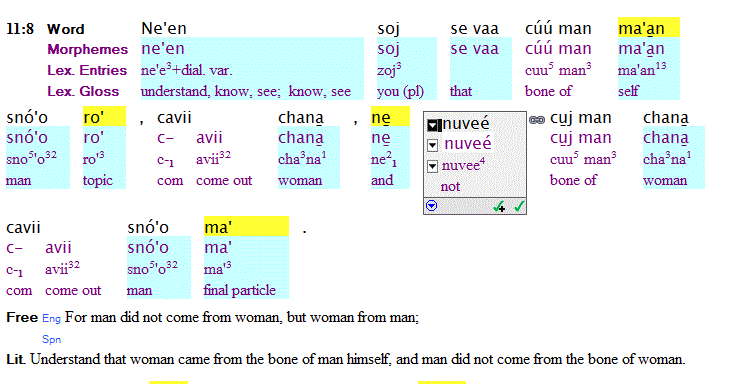
In a previous post here, I talked about the negative fronting construction.   The following two (sexist!) examples show that in the texts a positive contrast with the particle ro'  often seems to be paired with a corresponding negative contrast:


Another interesting note -- previously, I was aware that negative fronting involved the following pattern:

Nuveé {NP|PP} [S...]   "It is not {NP|PP} that ...."


I can now add CP to the list of fronted elements, due to examples like the following:


1 Cor 4:14


1 Cor 7:35


So the revised constructional template for negative fronting is


Nuveé {NP|PP|CP} [S...]   "It is not {NP|PP|CP} that ...."

Sunday, February 19, 2012

Causative constructions in Copala Triqui

The causative construction shows an unusual word order in Copala Triqui.  The normal order for these constructions is

[caused event]  'yaj SUBJ

Although the normal word order for Triqui is VSO, I do not think that causative constructions are ever in VSO order in natural text.  (The caused event clause, however, is in normal VSO order.)

The following passage shows a characteristic example.  (Note also that the aspect of the cause verb 'yaj typically matches the aspect of the verb(s) in the caused event.


Another similar example:


Far less common is the reversed pattern:

SUBJ 'yaj [caused event]

The examples I have seem to involve a causer subject that is fronted for some other reason, such as negation, or missing, due to relativization:


Another open question is the type of constituent the caused event may be.  In the examples above, it seems like a simple VSO clause.   But it is also possible for the caused event to contain some fronted material:


Here the caused event is [there:is:no illness [hit me]], where the noun chi'ii 'illness' has undergone the typical fronting to preverbal positions found with negative constituents.  (Maybe that is some sort of Focus Phrase?)


Saturday, February 18, 2012

Negative construction in Copala Triqui

The contrastive negative construction in Copala Triqui has the form

Nuveé {NP|PP} [S...]   "It is not {NP|PP} that ...."


For contrasting the object of a preposition, both preposition stranding and pied-piping of the PP are possible.  This example shows pied-piping:


Stranded prepositions in Copala Triqui, continued

In this previous post and this previous post, I talked about stranded material in Copala Triqui.

In the texts, the richest natural source of stranding is found in relative clauses.  Consider the following complicated passage, which has two strandings of rihaan 'to':


Another context for naturally occurring strandings is the contrastive negation construction Nuveé NP V... 'It is not NP that...'


The last clause here is literally 'It is not God who they give that meat to'