Showing posts with label testament. Show all posts

Monday, September 24, 2012

Hapax legomenon in Copala Triqui

The word quita'a' which appears in this verse (Romans 14:14) is the only instance of this word in the New Testament, and I am not clear what it is supposed to mean.


Here is the PDF of the relevant passage in Romans:


It seems as if it might be a form of the verb ta'aa 'take, catch', but what causes the final glottal stop to appear?

Thursday, February 23, 2012

Boosting corpus size for endangered languages

I've written several previous posts about methods for wrangling Bible translation material into Translation Editor and then into FLEx.  For an endangered language where there is an existing Bible translation, the amount of corpus material that can be added is fairly astonishing.

I ran the stats today on the Copala Triqui project today, and I think the numbers tell the story.   Within about 1/2 of the New Testament 'wrangled' into FLEx, the current project has around 100,000 words in it.


If we don't want to look at the translated material, we can filter it out by the Choose Texts menu:


(BTW, I made some mistake in genre type for the first few bits of Matthew that I experimented with, so don't show up in the Bible genre.  I could easily uncheck these as well, and at some point I will figure out what I have done wrong :-) )

If you filter out all the Bible material, the corpus is about 9,000 words:


A brief note -- Triqui is written in two orthographies (a practical one and a phonetic one).  The stats keep track of how many words are in each orthography as well as the total overall.

Tuesday, February 21, 2012

Itunyoso Triqui text on-line

I was pleased to see that there is some Itunyoso Triqui available online at this site, a bit of the translation of the book of James from the New Testament.  (I see that the whole Itunyoso Triqi testament is available as a PDF from some other sites, but they don't work for me, at least tonight.)  Because the same thing has been translated into Copala Triqui, I was curious to look at the similarities and differences.

Here is a bit of James 2 in Itunyoso and Copala Triqui:
Copala Triqui

Itunyoso Triqui


In a future post, I'll try to work out some sentence by sentence comparison.

Sunday, January 29, 2012

Stranded accusatives in Copala Triqui

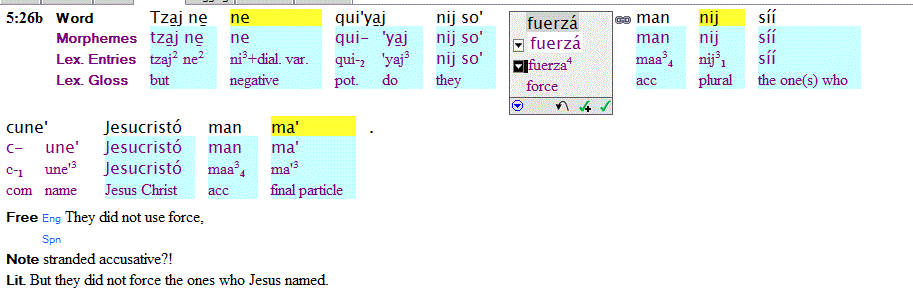
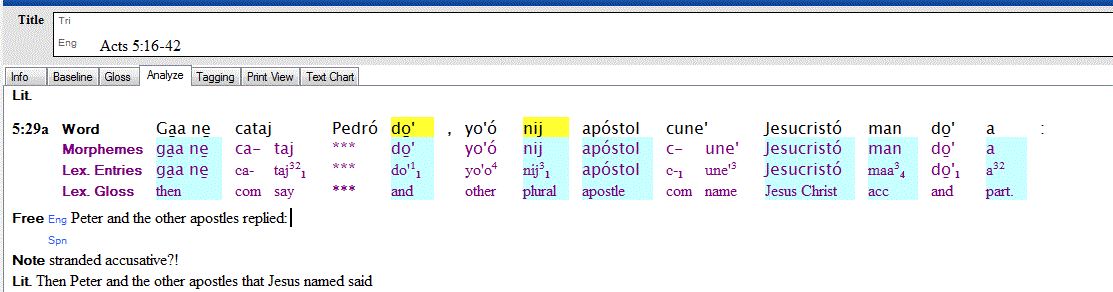
A small lesson for me on why it is useful to work through texts -- you encounter things that you would not have known were possible.  Today I found three examples of stranded accusative markers in the Copala Triqui New Testament translation, and this is a construction that I did not know was grammatical!


I think it probably important that all of these appear in relative clause contexts -- ''the apostles that Jesus named ACC", "the ones that Jesus named", and "the ones that you put in jail ACC".

Saturday, January 28, 2012

Why has the evil one entered your heart?

At least two things strike me as interesting about this passage.  One is that 'your heart'  doesn't require an obligatory accusative, even though 'you' would.  So possessed body parts occupy an interesting place on the hierarchy of direct object animacy.  The other is the phrase ndaa rihaan.  Ndaa alone means 'up to' and rihaan alone is 'to, for'.  The combination seems to mean 'even up to' or an emphatic version of rihaan.


Friday, January 27, 2012

More Triqui New Testament

I discovered today that Wordbibles.org  has a copy of the Copala Triqui New Testament in a format that is considerably easier to use than the PDF version of the Testament.  When you cut and paste from this site, all the font information is preserved (particularly the underscore diacritic and the saltillo.)  For the right column, you can cut and paste from an English translation.

I've been using copy and paste from this site along with Translation Editor to produce parallel versions of the first few chapters of Acts in this way.


Transferring the first sentence over to FLEx gives us


There are still some rough patches, but enough of the vocabulary is familiar to make this worth doing.

Wednesday, January 18, 2012

Words for think in Triqui

Why the two different words for 'think' in this passage from the Copala Triqui New Testament?  It seems that maybe guun rĂ¡ introduces a quote, while nuchruj raa is more of an intransitive


Wednesday, January 11, 2012

Triqui testament to FLEx, part 4


The following shows what this looks like in the Analyse tab for FLEx.

(Click to enlarge)


Working through this is a somewhat slow process, but I'm finding lots of new phrases and constructions this way. It expands the collection of texts to include a genre that I don't otherwise have good data for.

Triqui testament to FLEx, part 3

After clean-up, I used the Translation Editor function in FLEx (Bible translator edition) to neatly line up the Triqui version and its Spanish translation:

(Click to enlarge)


Then I used the Tools > Back Translation > Use Interlinear Text Tool to look at the same text in FLEx and to work on the Interlinear analysis.

Getting the Triqui New Testament into our FLEx project, part 1


For the last couple of months, I've been working on trying to get text from the Copala Triqui translation of the New Testament into the Fieldworks Language Explorer project to try to expand the range of textual and lexical material that we have available.

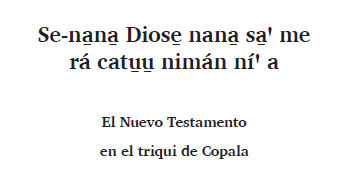
The PDF version of the text is available at worldbibles.org. Here is the front page of the volume

(A small note -- the actual published paper volume reflects an earlier orthography where low tone is marked with a line above the vowel. In Hollenbach's current orthography, this has been replaced with a line under the vowel.)