Showing posts with label discourse. Show all posts

Saturday, February 25, 2012

More on negative fronting


In a previous post here, I talked about the negative fronting construction.   The following two (sexist!) examples show that in the texts a positive contrast with the particle ro'  often seems to be paired with a corresponding negative contrast:


Another interesting note -- previously, I was aware that negative fronting involved the following pattern:

Nuveé {NP|PP} [S...]   "It is not {NP|PP} that ...."


I can now add CP to the list of fronted elements, due to examples like the following:


1 Cor 4:14


1 Cor 7:35


So the revised constructional template for negative fronting is


Nuveé {NP|PP|CP} [S...]   "It is not {NP|PP|CP} that ...."

Tuesday, February 14, 2012

Triqui topics and the reversed copula construction

Another environment for the ro' topic marker in Copala Triqui is what I'm calling the reversed copula construction.


Regular copulas have the normal order

 Predicate copula Subject

 as in examples like the following:


The reversed construction instead has the order

  Subject copula Predicate


and the ro' topic marker often shows up on the subject here, as in the following examples:


Triqui topic marking

In a previous post, I talked about uses of the Copala Triqui morpheme ro' .  One frequent context is when two phrases are being compared with each other. More searching through the corpus shows that the words ase vaa 'like' often precede and daj or danj 'thus, likewise'  is often between the two phrases.

The following example shows two clauses that are compared: "just as [Christ rose] ro', so [he will descend to the world'":


(We also see here that ro'  doesn't have to be attached to noun phrases.)

The next example compares what he (Cornelius) and his family did:


(We see here also that ro' is not necessarily preverbal.)

One more example of this from our Address to the Triqui People text:


A rather different use of ro' seems to be involved in a structure which is NP-ro' [V pronoun ...], where the pronoun is resumptive to the NP:


Here the element with ro'  "young people" precedes the verb "listen"  and is resumed with the pronoun nij so'.

(This example is also rather neat with its initial cleft structure; the pre-cleft element is the object of 'listen (to)', which is embedded under 'have the obligation'.)

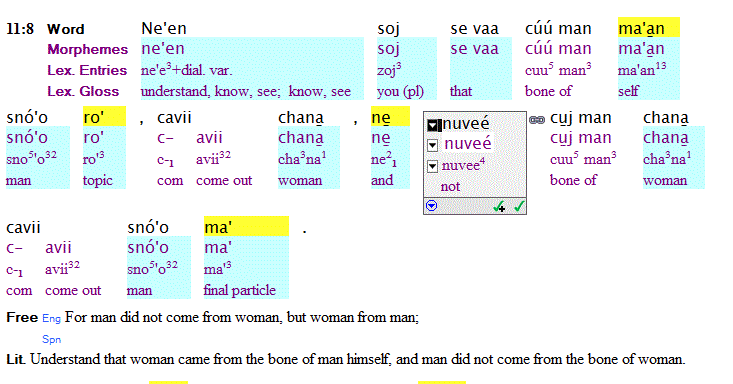
But the following two adjacent sentences show that a phrase with ro'  does not necessarily require a resumptive pronoun after the verb.  It is hard for me to say why one of these sentences has a resumptive and the other does not -- a speculation is that most of the phrases with ro'  are definite and 'each one' is not very definite.  So the daa 'o 'o determiner doesn't usually show up on phrases with ro' + resumptive.  However 'each one of the authorities together with all of their councils' is considerably more definite.  So perhaps definiteness accounts for the difference between sentences (23) and (24) below?

Saturday, February 11, 2012

Fronted phrases with maan in Triqui

I'm looking tonight at phrases with maan, which is rather inadequately glossed 'only' in my current lexicon.

The phrase preceded by maan is always (I think) clause initial and has some special discourse function -- maybe focus.  (I need to work out how it is different from the ro' topics, clefts with me se, etc...)

This topical phrase is sometimes a time adverb (either orá or tio, two words borrowed from Spanish, that mean 'time'):


It can also be a noun phrase.  In the following example, the cactus fruit with spines contrasts with the nice cactus fruits without spines which the rabbit threw in the previous episodes.


(This example also has preposition stranding in the fronted phrase)

Monday, January 16, 2012

Our current journal article


Our latest journal article, hot off the press at the Journal of Natural Language Engineering.  (A collaboration between linguistics, communication, and computer science.)

You can get a PDF of the article at my page at academia.edu